Talk to Our Expert
Our sales and engineers are available all the time, you can ask your specific requirements to our sales, and inspiration to our engineer here.

Most swatches lie.
That sounds harsh, but I mean it in a practical, commercial sense. A lot of display boards are designed to flatter the bottle for a few seconds, not to tell a buyer the truth about opacity, undertone, glitter density, magnetic movement, or whether the result on the stick can actually be repeated in a salon or on a production line. Buyers notice that gap faster than brands expect.
I’ve watched distributors pick up a swatch, tilt it under a phone flashlight, and immediately ask whether the shine came from the color itself or from the top coat. That moment matters. If the answer is vague, trust drops. And in a competitive market, vague presentation costs money.
The first problem is simple: too many brands confuse attractiveness with usefulness. A swatch can look polished, glossy, and expensive while still being a poor selling tool. If a buyer can’t tell how many coats were used, whether a base coat changed the tone, or whether a top coat created the finish, the display isn’t helping them evaluate the formula. It’s just decoration.
That matters more in a market where buyers are already cautious. In April 2024, Reuters reported L’Oréal’s Q1 sales rose 9.4%, with strong momentum in mass beauty, while Ulta warned of a category slowdown and intense competition. Put those two facts together and the message is obvious: demand still exists, but buyers are less forgiving of weak product presentation.
Here’s the ugly truth. A swatch display is not a beauty accessory. It’s evidence. It has to prove what the formula does under real conditions.
The easiest mistake to spot at a trade show is the giant rainbow ring with no logic behind it. It looks abundant, but abundance is not the same thing as clarity. For B2B selling, buyers are not only judging color. They are judging workflow, service time, training burden, price architecture, and whether a formula fits their salon model or private-label plan.
That’s why I prefer system-based displays. The gel polish catalog already points toward a better approach by separating collections by type and effect instead of dumping everything into one generic color wall. The OEM/ODM services page reinforces that logic from the manufacturing side with a 5,000+ color library, 3–5 day sample development, and minimum orders starting at 1,000 pieces per color.
If I were building a serious display, I would split it by formula family first. Standard 3-step color systems would sit in one section. Faster hybrid formats would sit in another. Builder-tint or structure-color hybrids would get their own area again. A buyer should be able to understand the system before they ever compare the shade.
That becomes even more important when you are selling newer shortcuts alongside classic formats. A standard color gel should not be displayed as if it performs the same way as a 2-in-1 rubber base gel color system or a 3-in-1 builder base format. Those products may overlap visually, but they do not behave the same way in service.
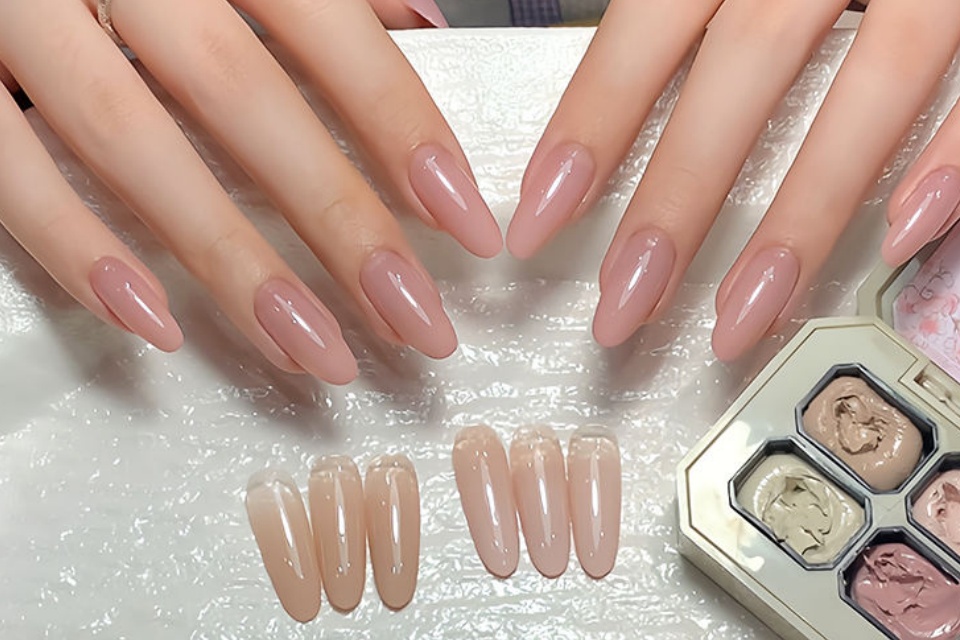
Most display problems come from missing context. The buyer sees the end look, but not the path that created it.
For gel nail swatches, that is a major problem. A professional sample should show more than color. It should tell the viewer whether they are looking at two coats, whether a top coat is present, what type of base was used, and whether the result is a salon finish or just a cured sample tip.
I would usually create at least three sample tips for a hero shade:
That may sound excessive until a buyer compares the swatch to actual production output and decides the sample was misleading. A little discipline upfront prevents a lot of arguments later.
This is especially important when assembling salon nail color samples for decision-makers who are comparing retail display potential with service practicality. The best nail swatch sticks don’t just look clean. They answer silent questions quickly.
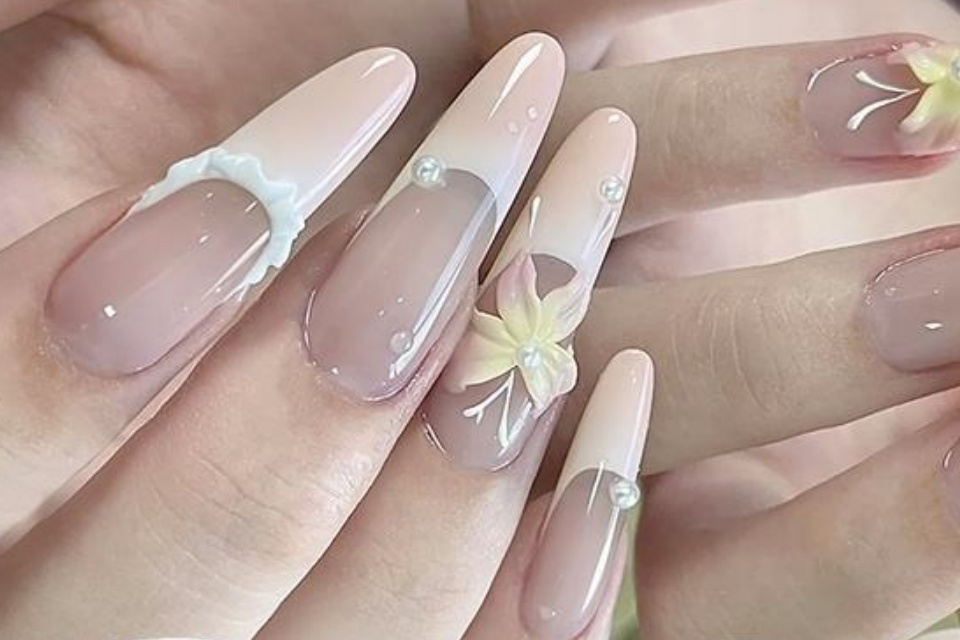
This is where a lot of brands lose credibility.
Cat eye gel is not a flat shade. It is an optical effect, and optical effects collapse when they are oversimplified. If you are selling from a cat eye gel collection, then your cat eye gel swatches need to show more than a single front-facing angle. Buyers need to see movement, base depth, and line clarity.
I would rather show two honest views than one dramatic but unrealistic hero sample. One swatch at a shallow viewing angle and one at a steeper angle tells the truth better than a single over-magnetized tip that no technician will ever reproduce consistently.
Glitter has a different problem. Too many brands treat all sparkle as one category. It isn’t. Fine shimmer, reflective glitter, flake glitter, dense glitter gel, and topper-style sparkle behave differently in formula and under light. A strong glitter gel polish display should make those differences obvious.
That is why a separate glitter gel series section makes sense. Density, translucency, particle size, and flash response should all be visible. If the product only becomes truly attractive under spotlight or flash, the display needs to show that honestly.
There is also a regulatory angle that smart suppliers should not ignore. The European Commission’s guidance on Regulation (EU) 2023/2055 matters for any business dealing with loose glitter materials or similar decorative components in Europe. That is not a side issue. It affects how products are communicated, positioned, and sometimes even displayed.
Lighting can rescue a display, or destroy it. I don’t trust a swatch board until I know what light is driving it.
Nudes shift. Reds flatten. Sheers die. Silver magnetic effects go muddy. Glitter either looks premium or cheap depending on the bulb. According to the U.S. Department of Energy, Color Rendering Index ranges from 1 to 100, with higher values producing less color shift, and many interior applications use 3,000–4,000 K sources. The DOE guidance also notes that 80 CRI is an acceptable minimum in many interiors. For color selling, I think that should be treated as a floor, not a goal.
If I am evaluating gel polish sample tips, I want a high-accuracy light source and clean labeling. At minimum, each swatch should state:
And yes, I would also separate sheer shades from opaque shades and display jellies over more than one substrate when relevant. A jelly over a clear tip and a jelly over a milky base can look like two different products. If your buyer needs to guess which scenario they are seeing, the display is underperforming.
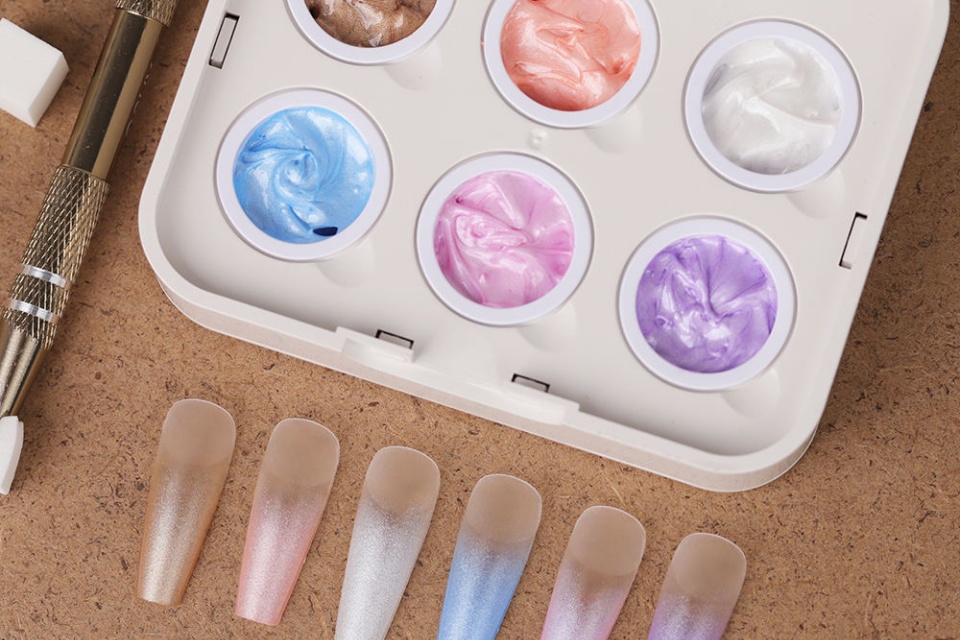
The best nail swatches for salons are rarely the biggest boards in the room. They are the clearest.
That means editing ruthlessly. For trade shows, I usually prefer 24 to 48 swatches, grouped by commercial purpose, not by rainbow order. Everyday salon shades, bridal neutrals, fast-selling glitters, magnetic statements, builder tints, and new-launch concepts can each have a place. But each group should have a reason to exist.
This framework works well:
| System or Effect | What the swatch must show | What usually goes wrong | Best display move |
|---|---|---|---|
| 3-step color gel | Base, 2 color coats, top finish | Board hides that gloss came from top coat, not color | Label layer order and cure time clearly |
| 2-in-1 colored rubber base | Coverage, leveling, structure, final finish | Buyer assumes it performs like a standard color coat | Show nail swatch sticks on short and full nail lengths |
| 3-in-1 builder base | Tint, structure, apex look, file/refine result | Product is sold as color when it is really a workflow shortcut | Add one raw cured tip and one finished salon-result tip |
| Cat eye gel | Magnet pattern, movement, viewing angle, base depth | Demo uses stronger magnet or darker base than production | Show two angles and name the magnet method |
| Glitter / reflective gel | Particle size, opacity, flash response, top-coat effect | Static swatch hides whether glitter is sheer or dense | Show daylight view plus spotlight or flash view |
| Trade show hero shades | Shelf impact and formula family | Too many colors, zero context | Curate by finish family, not rainbow order |
That table looks simple, but it solves a real commercial problem. It forces the display to do what buyers need: reduce uncertainty.
There is a legal and reputational side to all of this. If a swatch suggests an outcome that the buyer cannot realistically reproduce, then the display is not just weak. It is risky.
The FTC’s business guidance says advertising claims should be truthful, non-deceptive, and evidence-based, and in August 2024 the agency finalized a rule targeting fake reviews and testimonials, including AI-generated fake reviews. That guidance is worth reading, especially for beauty brands that rely heavily on visual claims.
The same principle applies to product proof. If you want your display to feel credible, connect it to documented process. The quality assurance page helps with that by pointing to ISO 22716, LIMS traceability, third-party testing, six-month stability testing, and 24-hour recall capability. Those are not decorative details. They support the selling environment around the swatches.
A buyer may first notice the color. But serious buyers eventually ask what stands behind the color.
Gel nail swatches are cured sample tips or sticks that display a formula’s real shade, opacity, finish, and effect under labeled conditions, helping salon buyers, distributors, and clients evaluate what the product actually looks like without guessing how many coats, what top coat, or which lighting setup created the final result. In practice, they work best when they show the full application context, not just a pretty color.
Cat eye gel swatches are sample tips prepared with a fixed base color, measured layer thickness, labeled magnet placement, and controlled viewing angles so the magnetic pattern, depth, and movement appear consistently instead of depending on booth lighting or an unusually strong demo technique. The safest method is to create one control swatch and one magnetized swatch side by side, with the magnet method labeled clearly.
Three-step systems and shortcut gel systems should not be swatched the same way because the visible finish, labor profile, and product function differ, meaning buyers need to see not only the final appearance but also the layer architecture and workflow that created that appearance. A 3-step sample can look glossier simply because the top coat is doing the work, while a hybrid base-color formula is selling convenience as much as color.
The best lighting for a glitter gel polish display is a high-color-accuracy light source that reveals undertone, sparkle density, particle behavior, and finish shift without pushing the shade too warm or too cool, ideally supported by a second controlled light condition for reflective or flash-reactive products. In practical terms, one honest main light and one effect-reveal light usually outperform an overlit booth with mixed bulbs.
A trade show board should include only the number of swatch sticks needed to explain the line clearly, which usually means a tightly edited, labeled set organized by finish and formula family rather than a large, exhausting color ring that looks impressive but slows decision-making. In most B2B settings, a disciplined board of 24 to 48 samples performs better than an oversized display with no hierarchy.
Start with a smaller, stricter system and make every sample earn its place. Use the gel polish catalog to organize by collection, support claims through the quality assurance process, refine concepts with OEM/ODM sample development, and direct qualified buyers through the contact page. A display that tells the truth sells better than one that only looks polished.