Talk to Our Expert
Our sales and engineers are available all the time, you can ask your specific requirements to our sales, and inspiration to our engineer here.

I’ve sat in enough product meetings to know how this usually goes: someone falls in love with a swatch wheel, someone else insists the line needs “more personality,” and before long the opening assortment has drifted from a tight commercial edit into a padded-out shade card full of overlap, vanity picks, and expensive optimism. Then the launch happens. Then reality happens.
Here’s the ugly truth. A starter palette isn’t supposed to impress your internal team. It’s supposed to survive first orders, salon feedback, and the second reorder window without turning into SKU clutter. That’s a very different brief, and I frankly believe most new brands don’t respect that difference early enough.
But this is the trap, right? More shades feel safer. More shades look bigger. More shades make the brand seem established—even when that “depth” is fake and the collection is really just three near-identical pink-beiges, two reds that cannibalize each other, and a couple of trend shades that looked sharp on a concept board but never had any business eating opening-order dollars.
It sounds harsh. It’s still true.
The wider beauty market has been pretty blunt about what happens when demand gets choosier. According to Circana’s August 2024 U.S. prestige beauty report, prestige beauty sales grew 8% to $15.3 billion in the first half of 2024, while mass-channel beauty stayed flat; then Reuters reported in August 2024 that Ulta cut guidance as demand for higher-priced cosmetics and fragrances softened. I read that as a warning. Buyers are still buying, yes—but they’re less patient with muddled assortments, slower turns, and lines that confuse novelty with actual demand.
And the working channel is still there. Still active. The U.S. Bureau of Labor Statistics says manicurists and pedicurists held about 210,100 jobs in 2024, with employment projected to grow 7% from 2024 to 2034 and roughly 24,800 openings a year. So this isn’t some tiny hobby corner of beauty. It’s a real service market with real reorder behavior—which means brands that launch like they’re styling a photo shoot instead of building a sellable line are setting themselves up for unnecessary drag.
Yet ten shades is enough. More than enough, really, if the range is doing honest work and not trying to cosplay as a 40-SKU mature brand before it has earned that breadth through actual sell-through, repeat purchase data, and cleaner channel feedback from salons, distributors, and private-label buyers who care about movement, not mood boards.
Ten works.
From my experience, 10 is where the collection stays legible. A buyer can scan it fast. A salon owner can understand the range without a speech. A distributor can pitch it without inventing a narrative to explain why half the shades exist. That matters—a lot more than founders tend to think when they’re still staring at pretty lab samples.
My split is simple, and I’m not changing it because it keeps proving itself: four nudes, three reds, two seasonal-but-still-wearable shades, and one utility neutral. That’s the skeleton. The line can get louder later.
Would I launch with 18 or 24 if someone pushed hard enough? Maybe. But I’d call it what it is: risk disguised as ambition.
| SKU | Shade | Color family | What it does in the line | Why it earns shelf space |
|---|---|---|---|---|
| N01 | Milky Sheer Pink | Nude | Natural manicure, bridal, overlay-friendly | High repeat use, forgiving, photographs cleanly |
| N02 | Warm Beige Nude | Nude | Everyday office-safe neutral | Broad mainstream appeal across channels |
| N03 | Rosy Nude | Nude | Brightens the hand without looking loud | Sells to clients who think beige looks flat |
| N04 | Greige Taupe Nude | Nude | Cooler neutral option | Stops your nude range from skewing too warm |
| U01 | Creamy Off-White | Utility neutral | French tips, milk-bath looks, art base | Essential for salons and content versatility |
| R01 | Classic Blue-Red | Red | Evergreen hero red | Timeless, high-conversion, premium-looking |
| R02 | Brick / Chili Red | Red | Fashion red with autumn depth | Feels trend-aware without becoming disposable |
| R03 | Black Cherry / Wine | Red | Dark luxury red | Strong seasonal pull and high perceived value |
| S01 | Mocha Brown | Seasonal core | Fall-to-winter neutral with fashion crossover | Modern, wearable, and stronger than people think |
| S02 | Dusty Sage | Seasonal core | Soft differentiator | Gives the collection personality without going weird |
Here’s where outsider logic falls apart. Not every bottle in a launch line has the same job. Some shades are traffic drivers. Some are reputation shades. Some are workhorse SKUs that keep the salon chair happy even if nobody on the brand team writes poetry about them.
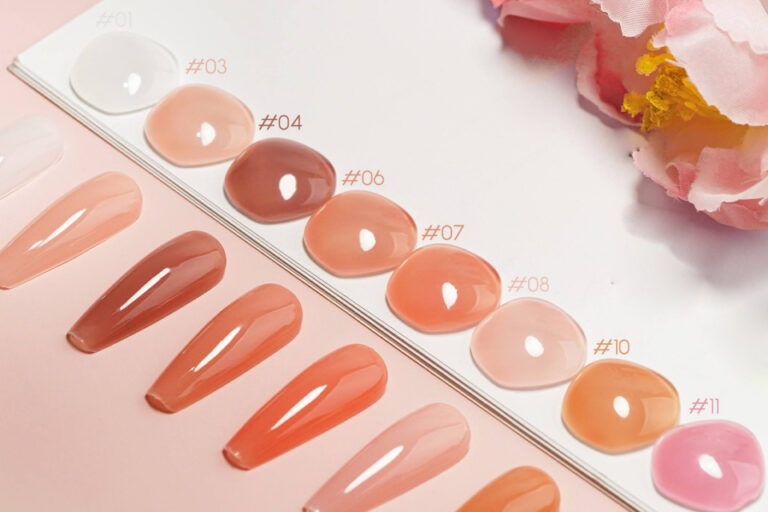
Nude gel polish shades do the heavy lifting. They just do. A milky sheer pink gives you bridal, overlay, clean-girl manicures, and that natural-finish look that keeps pulling people back into the chair. A warm beige nude handles everyday neutrality. A rosy nude saves the customer who finds beige too flat. A greige taupe cools the palette down so the range doesn’t skew peachy and repetitive—which, frankly, is one of the most common rookie mistakes I see on early shade cards.
And the creamy off-white? That bottle earns its keep. French tips, milk-bath looks, soft art bases, bridal sets, minimalist manicures—it’s not there to be flashy. It’s there to work.
Red plays a different role. A classic blue-red is your benchmark shade; if that one looks weak, jelly-ish, patchy, or off-tone under salon lighting, people clock it instantly. Then the brick or chili red gives the line warmth and fashion edge without getting gimmicky. Black cherry or wine deepens the block, pushes premium perception, and gives the collection a colder-season anchor that still feels wearable.
The seasonal pair should be controlled. That’s the key. I like mocha because it has already moved beyond trend-chasing and into near-core territory for many buyers. I like dusty sage because it gives the line some breath—some shape—without tipping into novelty. It’s different, but not weird. Big distinction.
However, this is where a lot of brand decks start sounding smart and then fall apart the second someone asks about opening depth. Founders will spend weeks debating undertones and bottle caps, then split inventory evenly across all shades as if every SKU has the same velocity profile, the same reorder odds, and the same role in the line. That’s not planning. That’s wishful arithmetic.
I’d go deepest in N01, N02, and R01. No hesitation. Those are your anchor bottles. Then I’d go medium depth in N03, N04, U01, and R02. After that, lighter depth in R03, S01, and S02. Not because those last shades are weak—they’re not—but because their job is breadth and identity, not opening-order dominance.
That’s why I’d start with a full gel polish catalog for brands, distributors, and salon chains before I got too precious about individual shade names. You need the whole system view first: where core colors sit, how effect categories are segmented, what the support products look like, where the range can go later. Then—and only then—I’d narrow into the private label color gel range.
That order matters.
Do it backwards and you end up over-indexing on pretty samples instead of building a line that can actually breathe once sales data shows up.
But a clean palette can still fail if the back end is sloppy. I’ve seen brands obsess over the “perfect” nude while barely checking the boring stuff—batch consistency, viscosity control, cure behavior, approval loops, label execution, carton logic, refill plans, shade drift over repeat production. That stuff isn’t sexy. It’s also where real problems live.
I’d review OEM/ODM gel polish services before final approval, because not every brand needs the same path. Some genuinely need OEM-level customization. Others really need speed, lower development friction, and a formula platform that already works. Founders mix those up all the time, and it costs them months.
Then there’s the paperwork nobody wants to talk about until a buyer asks for it. The ISO 22716 quality assurance system matters because traceability, QC checkpoints, and approval records aren’t “nice extras” in B2B—they’re part of the commercial offer. If the range can’t hold up operationally, the shade story won’t save it.
And, yes, formula compliance now sits right in the middle of the conversation whether brands enjoy that or not. The European Commission’s guidance on TPO in nail products says TPO was classified under Commission Delegated Regulation (EU) 2024/197 as a category 1B reproductive toxicant, which triggered its inclusion in Annex II of the Cosmetics Regulation via Regulation (EU) 2025/877. That changes how smart brands think about formula architecture, export flexibility, and long-term assortment planning.
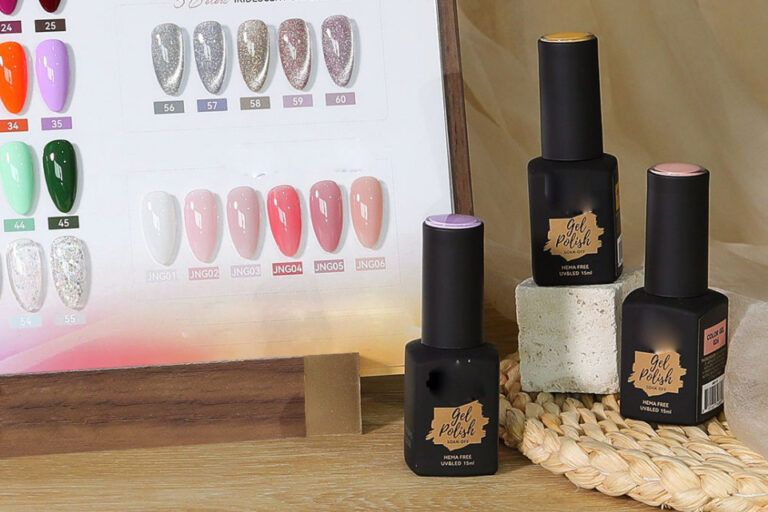
And one more thing—packaging format is not a side note. The page for custom 10–15ml gel nail polish color sets is useful precisely because it pulls bottle sizing, refill logic, and HEMA-free and TPO-free positioning into the same commercial frame. That’s how real launch planning should look: not just color, but container, compliance, scale, and margin working together.
Yet this is where people lose discipline. They want cat eye. Reflective. Disco glitter. Jelly syrup finishes. Every shiny thing on the swatch rail. I get it. I really do. Those categories photograph beautifully, and they can absolutely move—later.
Wave one is not the place for too much flair.
I wouldn’t lead with neon-heavy assortments. I wouldn’t build the first collection around multiple effect stories. I wouldn’t let the opening range get dragged off-course because a couple of sparkle shades looked strong in content testing. The job of wave one is to establish credibility and reorder logic. The job of wave two is to get more expressive once the core line has already proven it can hold the floor.
That sequencing changes the whole commercial read. A tight core range says the brand has control. A later effect drop says the brand has momentum. Reverse that order and, too often, the line starts to look under-edited and slightly desperate.
The best gel polish colors for a new brand are commercially reliable, broadly wearable shades that cover daily demand, salon utility, and limited seasonal variation, which usually means a tightly edited mix of flattering nudes, one utility off-white, classic reds, and one or two controlled fashion shades.
In practice, I’d start with sheer pink, beige nude, rosy nude, greige taupe, creamy off-white, classic blue-red, brick red, black cherry, mocha, and dusty sage. That lineup is balanced, sellable, and much easier to reorder intelligently than a bloated opening assortment.
A smart gel polish launch collection usually starts with 8 to 12 shades because that range is wide enough to establish credibility, cover multiple undertones and use cases, and support real sell-in conversations, while still staying disciplined on MOQs, sampling costs, photography, and reorder planning.
I’d still pick ten. It keeps the line looking complete without letting weak filler shades sneak in under the excuse of variety.
A starter palette should focus mainly on nude gel polish shades, with seasonal gel polish colors used as controlled accents, because nudes carry the broadest repeat-use demand and salon utility, while seasonal tones add distinction and campaign freshness without needing the same opening-order depth.
My bias is clear: nudes first, reds second, seasonals third. Not because seasonals don’t matter—but because they shouldn’t be asked to do the heavy commercial lifting.
To choose gel polish colors for a product line, assign each proposed shade a distinct commercial role—core nude, utility neutral, hero red, deeper red, or seasonal differentiator—and then keep only the shades that have a clear purpose, consistent appearance, channel fit, and a realistic path to stable reorders.
If a shade can’t explain its job, I cut it. That rule sounds strict, but it saves brands from a lot of expensive sentimentality.
So, yes, I’d keep the first palette tight. Not timid. Tight.
That’s the distinction that matters. A strong launch collection doesn’t try to say everything on day one. It says the right things clearly, sells through the obvious winners, and leaves space for later extensions that are earned by data—not by impulse.
To turn this gel polish launch collection into an actual supplier brief, start with the catalog, review the OEM/ODM options, check the quality documentation angle, and then contact the team with your target market, bottle size, and the 10 shades you want sampled first.