Talk to Our Expert
Our sales and engineers are available all the time, you can ask your specific requirements to our sales, and inspiration to our engineer here.

It sounds efficient. And in a category obsessed with saving minutes, shrinking SKUs, and giving distributors one more “easy sell” story, a bottle that claims to do base, color, and top in one is obviously going to get attention from salons, private-label brands, and impatient DIY buyers alike. But attention is cheap. Retention is not.
So, will 3-in-1 gel polish actually change buying behavior?
My answer is blunt: yes, but only at the edges first. I don’t buy the fantasy that all-in-one systems will wipe out conventional base coat, top coat, and pro-grade gel polish assortments. What I do believe is this: 3-in-1 formulas can carve out a profitable lane where speed matters more than maximum wear, where starter kits need simplicity, and where private-label brands want a low-friction hero SKU before building a bigger system.
Because labor is expensive. Because attention spans are shorter. Because first-time buyers hate complicated systems.
That is the ugly truth. A conventional three-step gel service asks the user to understand adhesion, viscosity, pigment load, cure behavior, inhibition layer management, and finish performance. A 3-in-1 pitch erases that complexity with one promise: “Use this bottle, cure it, move on.” For entry-level users and mass-market retail, that promise is powerful.
And the broader nail business still has momentum behind it. U.S. Bureau of Labor Statistics data published in July 2024 said employment for manicurists and pedicurists was projected to grow 8.7% from 2022 to 2032, which tells me nail services are not fading into some tiny hobby category. Demand is there. The fight is over service model, speed, and margin structure. (Bureau of Labor Statistics)
Beauty demand, more broadly, also stayed resilient entering 2024, with Circana saying the industry remained strong after two years of major growth. I would treat that as a tailwind for experimentation, including simplified nail systems, though that part is my inference rather than a direct Circana claim about 3-in-1 gels specifically. (Circana)
Here’s the part marketers like to blur.
A base coat is built to grip. A color coat is built to deliver opacity and shade stability. A top coat is built to resist staining, scratching, and dullness while curing into a smooth, attractive surface. Asking one bottle to do all three jobs well is not impossible, but it is a compromise by design.
That compromise usually shows up in one of four places: weaker adhesion on oily or flexible nails, lower opacity in fewer coats, softer surface feel after cure, or less impressive long-wear shine. You can improve one axis, sure. But the formula bill comes due somewhere else.
And there’s also the safety and regulatory side, which serious buyers can’t shrug off. The FDA’s nail-care guidance says nail products sold in the U.S. must be safe under labeled or customary use, and it notes that many nail products contain potentially harmful ingredients even when they are legally sold. OSHA’s nail salon guidance is even less romantic; it lists chemical hazards tied to products used in salons, including methacrylate compounds, formaldehyde, toluene, and dibutyl phthalate, and stresses that repeated exposures can add up. (U.S. Food and Drug Administration)
That matters more for all-in-one formulas than some brands admit. Why? Because when you compress multiple functions into one bottle, your tolerance for sloppy formulation gets smaller, not bigger.
I’m not talking about internet panic. I’m talking about published data.
A 2024 retrospective study from Amsterdam, available through PubMed, found 67 patients diagnosed with allergic contact dermatitis from acrylate-containing nail cosmetics between 2015 and August 2023; 97% had a positive patch test to HEMA, and avoidance of acrylate-containing products cleared dermatitis in 80% of patients. Another related HEMA patch-testing study found that in patients with relevant reactions, 67% of non-occupational allergic contact dermatitis cases were caused by nail cosmetics. That is not niche noise. That is a formulation warning siren. (PubMed)
Then there is worker exposure. A 2024 paper indexed on PubMed reported nail salon workers’ exposure to photoinitiators in dust at an estimated 4.86 ng/kg body weight/day, with 10% to 42% of the photoinitiators in ingested dust becoming bioaccessible in simulated digestion. Meanwhile, a 2024 Rutgers study surveying New York and New Jersey nail salons found 79% of New York salons had mechanical ventilation versus 52% in New Jersey, while 67.6% of manicurists reported symptoms related to chemical exposure. (PubMed)
So no, I would not position 3-in-1 as “the future” unless the formula has been stress-tested hard, the cure profile is clean, the claim language is disciplined, and the SDS/documentation package is solid. That’s where real quality assurance stops being brochure fluff and starts protecting the brand.
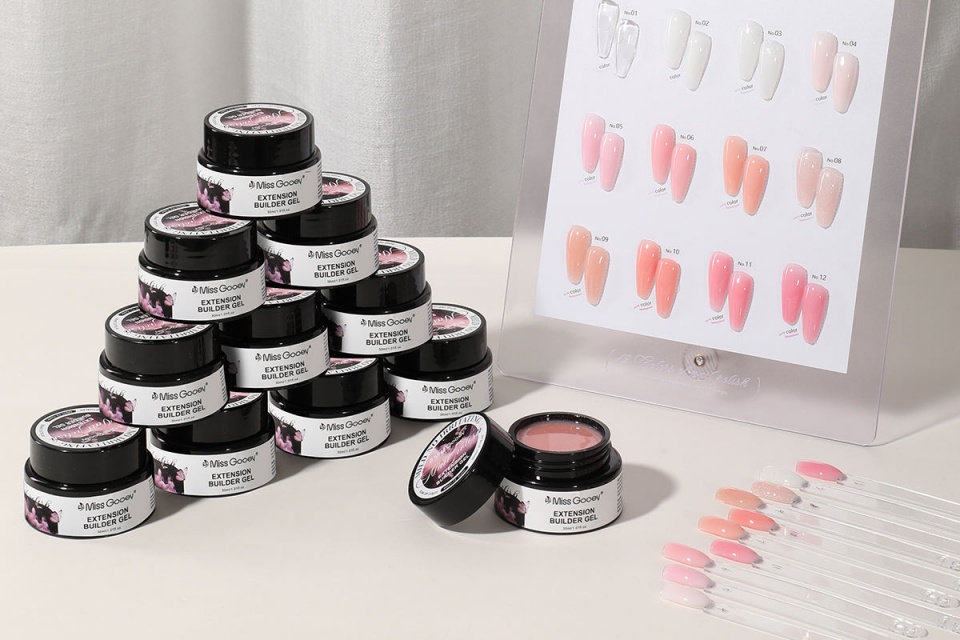
This is where I think brands can make money without lying to themselves.
First, starter systems. If a beginner can buy one bottle, one lamp, one remover, and get a presentable result, conversion gets easier. Second, travel and express-service concepts. Third, color collections aimed at quick-change users who value convenience over 21-day salon-grade endurance. Fourth, B2B private label catalogs that need a simple “entry formula” before upselling into layered systems.
That is why a product like your 3-in-1 rubber builder base gel is commercially interesting. It doesn’t have to replace every SKU in a catalog. It just has to give distributors, new brands, and fast-service operators a believable shortcut.
But believable is the key word. If the bottle claims “base + color + top,” then it has to be tested across short nails, flexible nails, darker pigments, different lamp outputs, and uneven application habits. Otherwise, the return rate will eat the convenience story alive.
Because professionals don’t just buy products. They buy control.
A salon tech wants to adjust adhesion independently from color opacity. They want a matte or high-gloss finish without reformulating the whole service. They want to fix one failure point without trashing the entire protocol. That’s why separate gel polish, base coat, and top coat families still make operational sense.
And there’s another thing professionals understand that retail buyers often miss: premium services are sold on reliability, not bottle count. If a three-step system gives five extra days of stable wear, better scratch resistance, and fewer emergency fixes, many salons will gladly keep the “extra” steps. Time saved in application can be lost again in callbacks.
This part is not theoretical.
The European Commission’s TPO Q&A explains that TPO was classified as a CMR category 1B reproductive toxicant by Commission Delegated Regulation (EU) 2024/197, with that classification applying from 1 September 2025, and that this triggered its prohibition in cosmetic products through Regulation (EU) 2025/877 from the same date. The Commission also notes there was no sell-through or professional-use carveout after the cutoff.
Why do I bring that up in a 3-in-1 article? Because streamlined products are only commercially attractive if their chemistry survives compliance pressure. If your all-in-one formula depends on ingredients that are already drifting into a regulatory gray area, you are not building a hero SKU. You are building future dead stock.
Here’s my position.
3-in-1 gel polish will grow. It will not replace layered professional systems at the high-performance end. It will win where simplification beats specialization: starter kits, express services, mass retail, travel formats, certain private-label lines, and some budget-conscious salon menus. It will also push mainstream brands to sharpen claims around faster cure, easier removal, and fewer-step systems.
But the hard ceiling remains the same. The more jobs one bottle is asked to do, the harder it is to make each job excellent.
That’s not failure. That’s just product physics.
| Factor | 3-in-1 Gel Polish | Traditional Base + Color + Top |
|---|---|---|
| Application speed | Faster, simpler workflow | Slower, more steps |
| Training curve | Lower for beginners | Higher, but more controllable |
| Adhesion tuning | Limited | Stronger, adjustable by nail type |
| Finish options | Narrower | Wider: matte, gloss, no-wipe, reinforcement |
| Shade opacity consistency | Can vary more by pigment load | Easier to optimize separately |
| Professional retention potential | Good in selected use cases | Usually better for premium wear targets |
| SKU simplification | Excellent | Poorer |
| Claim risk | Higher if overpromised | Lower when each layer has one job |
3-in-1 gel polish is a UV/LED-curable nail coating formulated to combine adhesion, color payoff, and surface protection in one bottle, allowing users to skip a separate base coat and top coat when the nail condition, lamp output, and wear expectations fit the formula’s performance window.
That is why it appeals to beginners, fast-service salons, and private-label brands. It reduces friction. It does not eliminate formulation trade-offs.
3-in-1 gel polish works by blending film formers, photoinitiators, pigments, adhesion-supporting ingredients, and finish-building resins into one balanced formula so the cured coating can bond to the nail, display color, and leave a protective surface without relying on separate supporting layers.
The catch is balance. Improve grip too much and removal may suffer. Push shine too hard and flexibility can drop. Formula work gets tighter, not easier.
All-in-one gel polishes are worth it for salons when the business model favors speed, starter services, quick color changes, and low-SKU menus more than maximum customization, long-wear premium pricing, or technical correction of different nail conditions across a varied client base.
For express menus, yes, often. For elite retention-focused work, I would still keep separate systems close at hand.
3-in-1 gel polish is not automatically safer than traditional gel systems, because product safety depends on full formula design, ingredient choices, cure behavior, labeling, worker handling, and ventilation practices rather than on whether the product combines three service steps into one bottle.
Recent allergy and exposure data in nail cosmetics should make every buyer more disciplined, not more relaxed. Faster service is nice. Safe chemistry is better. (PubMed)
If you’re planning a private-label launch, I’d treat 3-in-1 as a strategic add-on, not your whole identity. Build the shortcut SKU, yes—but back it with serious testing, a clean claims strategy, and a catalog that still includes specialist options through your OEM/ODM services. That way you can sell convenience without trapping the brand inside it.