Talk to Our Expert
Our sales and engineers are available all the time, you can ask your specific requirements to our sales, and inspiration to our engineer here.

Semi-cured gel nail strips didn’t get popular because the industry suddenly discovered a better molecule, a better lamp, or a better salon protocol; they got popular because they shave off friction at almost every consumer pain point—mess, skill, cleanup, and choice overload—while still giving a result that looks polished enough for Instagram, work, dinner, and repeat purchase. That’s the real hook.
But here’s the ugly truth. Convenience sells faster than expertise.
I frankly believe a lot of people still frame this category the wrong way. They ask whether strips are “better” than bottled gel, as if the market is a neat lab test. It isn’t. It’s retail psychology, service design, chemistry, and habit formation all mashed together. Semi-cured strips are strongest when the buyer wants speed and predictability. Traditional gels still win when the nail itself is the problem—lifting, weak sidewalls, peeling free edge, bad prep history, you name it.
Anecdotally, this is the easiest trend to explain in the room. You show someone a bottle of gel polish, then you show them a finished strip set with foil, marble, or chrome-adjacent shine, and they don’t think about viscosity, cuticle flooding, or cure intervals. They think: “That looks easy. I can do that tonight.”
And that matters. A lot.
That’s why the category keeps pulling attention from beginners, casual DIY buyers, and brands that care about visual sell-through. With semi-cured sticker gel products, the merchandising is almost built in. The customer sees the final look first. Then—maybe later—she graduates into broader gel polish systems. From a funnel perspective, that’s cleaner than asking a new customer to understand prep liquids, base chemistry, cure timing, tacky layers, and top-coat finish from day one.
From my experience, that’s the whole commercial edge. Not superior chemistry. Not some magical wear breakthrough. Just less friction, fewer steps, and a lower intimidation factor.
Yet this is where the marketing gets slippery. Semi-cured strips are often sold as partly cured gel—commonly around the 60% mark—but that doesn’t mean they’ve escaped the usual acrylate conversation. Different format, same family of headaches. And yes, the distinction matters more than some brands want to admit.
The evidence is not subtle. In a 2024 tertiary-centre study, 153 of 396 patients tested with a nail acrylate series were positive for at least one acrylate, and 2-HEMA identified 85.6% of those cases. That’s not a rounding error. That’s a warning light. See the 2024 acrylate allergy study. If a product still depends on light-cured gel chemistry, the “it’s basically just a sticker” line doesn’t hold up for long.
And the U.S. position isn’t especially forgiving, either. The FDA states that nail products may contain potentially harmful ingredients but are allowed on the market when they are safe under labeled or customary use, and labels must give adequate directions and warnings when needed for safe use. Translation? Brands don’t get to hide behind aesthetics. They need discipline. See the FDA’s Nail Care Products guidance and Cosmetics Labeling Guide.
It gets more practical than that. The British Association of Dermatologists reiterated in 2023 that at-home artificial nail kits can increase the risk of allergic reactions when uncured product contacts the skin or when curing is inadequate. They also note that latex and vinyl gloves aren’t enough protection here—which, frankly, a lot of people in the trade still ignore. Read the BAD warning on at-home artificial nail kits.
Now, to be fair, semi-cured strips do some things extremely well. Better than many low-skill gel users, actually. They reduce the number of failure points during application. Less brushwork. Less pooling. Less chance of wrecking the sidewalls because someone overloaded product near the cuticle and then flash-cured a mess.
It works. Usually.
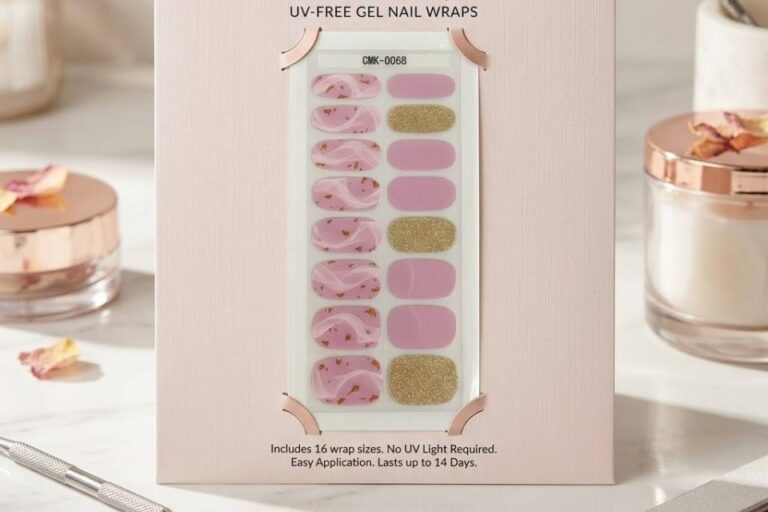
They’re also excellent at design consistency, which sounds basic until you’ve watched a brand try to scale consumer demand with bottled effects that depend on hand control. A strip can deliver repeatable pattern placement, repeatable sparkle, repeatable alignment. That’s why design-led SKUs like blue gold marble semi-cured gel nail stickers, rainbow foil semi-cured UV gel nail strips, and glossy red semi-cured gel sticker strips are so easy to push online.
And that’s the real story—not glamour, not hype, just clean repeatability. Consumers don’t buy a production process. They buy a finish they trust they can get without swearing at a brush for 40 minutes.
But salons aren’t living on simple color alone, or at least the smart ones aren’t. Traditional gels still own the jobs that require structure, correction, strategy, and actual technical judgment. Once you’re dealing with apex placement, reinforcement, rebalancing, repair, overlays, or an uneven nail plate, strips stop looking like a replacement and start looking like a shortcut with limits.
That’s not a knock. It’s just the category boundary.
I’ve said this before, and I’ll say it more bluntly now: surface beauty is not the same as performance. A manicure can look expensive on day one and still fail because the underlying nail needed support, not decoration. That’s why builder gel options still matter. That’s also why serious operators care about quality assurance processes rather than just trend velocity. If the nail is thin, damaged, oily, over-filed, or prone to lifting, a nice strip design won’t rescue the wear.
That’s where pro systems still earn their keep. Not in the photo. In the retention.
Here’s the industry-side read, and I don’t think it’s especially controversial if you’ve been around the category for a while: semi-cured strips are a selective substitute, not a total channel replacement. They pressure the easy money first—basic color services, low-differentiation salon appointments, quick-turn beauty retail, impulse buys, giftable sets, starter kits.
Weak menus get hit. Strong ones don’t.
A salon that mainly sells speed is vulnerable. A salon that sells diagnosis, nail rehab, builder structure, custom shaping, retention planning, and actual design skill is playing a different game. That kind of business doesn’t compete with strips head-on. It competes with mediocrity.
On the supply side, the smarter move is building a ladder, not a fad. Start with a simple entry point, then expand into support products and professional-use systems. That’s where OEM and ODM manufacturing services and a broader best gel polish product catalog become strategically useful. Not glamorous, no. But useful. A real brand needs more than one hero SKU and a nice carton.
I don’t think this needs overcomplication. The split is pretty clear once you stop pretending every manicure problem is the same problem.
| Factor | Semi-Cured Gel Nail Strips | Traditional Gels |
|---|---|---|
| Primary strength | Speed, consistency, ease of use | Customization, structure, retention control |
| Skill requirement | Low to medium | Medium to high |
| Mess and waste | Low | Moderate |
| Design repeatability | Very high | Depends on technician skill |
| Structural support | Limited | Strong |
| Suitability for damaged or difficult nails | Limited | Stronger |
| Best sales channel | DTC, online visual retail, impulse purchase | Salons, professionals, specialist distributors |
| Main risk misconception | Seen as “just stickers” despite gel chemistry | Seen as purely professional despite rising DIY adoption |
| Best use case | Fast, design-led manicure | Long-wear professional manicure, repair, overlays, extensions |
So, no, the market doesn’t need a dramatic winner. That’s usually influencer logic, not category logic. Semi-cured strips handle convenience-led demand really well. Traditional gels still handle performance-led demand, problem nails, and high-value salon work. There’s overlap, sure—but not enough to call one a full replacement for the other.
Semi-cured gel nail strips are pre-formed adhesive gel layers that are partially cured before sale and then fully set on the nail with UV or LED light, giving users a faster and more standardized manicure than bottled gel while still relying on light-cured gel chemistry. Think of them as a hybrid format. They borrow the simplicity of a wrap and the finish logic of a gel system, which is exactly why they appeal to beginners and annoy purists.
Semi-cured gel nail strips are better than gel polish when the priority is speed, low mess, design consistency, and easier home application, but they are not better when the priority is structural support, advanced customization, retention management, or professional correction of the natural nail. That’s the honest answer. They’re better at convenience. They’re not better at everything, and pretending otherwise usually means someone is trying to sell inventory.
Applying semi-cured gel nail strips means preparing the natural nail carefully, choosing the closest size, pressing the strip without wrinkles or air pockets, trimming the excess cleanly, and curing according to the brand’s instructions so the gel sets properly without touching surrounding skin. Prep matters more than most tutorials admit. If you rush the fit, leave oil on the plate, or let product kiss the skin at the sidewalls, wear time drops and irritation risk goes up.
Semi-cured gel nail stickers damage natural nails mainly when removal is forced, the nail plate is over-filed, the product is under-cured, or the user becomes sensitized to acrylates, which means the format itself is not automatically damaging but misuse can lead to real problems. In plain terms, the damage usually comes from bad handling. Not from the package name. Rough removal, repeated trauma, and sloppy curing are what turn a convenience buy into a nail-health issue.
Semi-cured gel nail strips replace some salon visits only in the low-complexity segment, especially basic color services, but they do not replace expert prep, builder structure, repair work, extensions, detailed diagnosis, or high-value customization, all of which remain firmly in the professional domain. They’ll absolutely steal some easy appointments. They won’t replace the technician who knows why a set keeps lifting on two fingers and how to fix it.
If you’re building content or product strategy around this category, don’t force a fake war between formats. The smarter position is simpler than that: semi-cured strips serve the convenience buyer, traditional gels serve the performance buyer, and the brands that understand both sides usually make better decisions—and fewer embarrassing claims.