Talk to Our Expert
Our sales and engineers are available all the time, you can ask your specific requirements to our sales, and inspiration to our engineer here.

PolyGel nails sell because they feel like cheating. Less smell, less mess, less panic.
And yes, I’m going to say the quiet part out loud: most “innovation” in nail enhancements is just packaging old chemistry into a new workflow, then letting social media do the distribution—but PolyGel (acrygel, acrylic-gel hybrid nails, whatever label you prefer) actually changed how technicians move their hands at the table, which is why it stuck.
So why is it taking off now, specifically?
Because the market has two giant pressures pushing in the same direction: speed and control. Salon owners want predictable service times. DIY users want fewer failure modes. PolyGel nails hit that sweet spot: thick enough to stay put, strong enough to wear, flexible enough to feel less “glass-like” than some hard gels, and (usually) less nose-burning than classic liquid monomer acrylic.
But there’s a second story nobody wants to put on the product page. Allergy risk. Regulation risk. Labeling risk. And it’s getting louder.
In Amsterdam, clinicians are openly warning that acrylate allergy cases are rising, and they’re pointing at gel products and the way people apply them—especially when cuticles get nicked and uncured product touches skin; they even cite a current “4% sensitivity” figure among tested patients, described as double the rate from a decade ago. (amsterdamumc.org) That’s not internet panic. That’s a hospital saying, “we’re seeing it.”
Now layer in raw workforce reality: in the U.S. alone, there were about 145,000 manicurists and pedicurists in May 2023, with average annual pay of $36,480, and BLS lists 210,100 jobs in 2024 with a $16.66 median hourly wage (May 2024). That’s a big exposure surface area, even before you count DIY. (bls.gov)
This is why PolyGel nails are “taking off” and why smart brands treat it as more than a trend: it’s a workflow shift happening inside a chemical category that regulators and dermatology clinics are watching more closely.
PolyGel is basically a pre-mixed, viscous builder material that cures under UV/LED—thick like paste, not runny like monomer liquid. It gives you acrylic-ish strength without the same mixing rhythm, and it gives you gel-ish finishing without the same “runaway self-leveling” problems that punish beginners.
It’s also not magic. It’s still an acrylate/methacrylate world. The exposure problem doesn’t vanish just because the jar smells nicer.
The hard truth: the “best” system is the one you can cure fully, file predictably, and remove without shredding the nail plate.
That’s it.
PolyGel wins in salons because it reduces rework.
Acrylic rework often comes from the mix. Too wet, too dry, wrong ratio, humidity swings, monomer choice—then the nail tech fights the product instead of shaping. Gel rework often comes from flooding and leveling: product slides into the sidewalls, cures there, and now you’re filing a mistake you baked into place.
PolyGel splits the difference. It holds shape while you build. It waits for you. That’s the real product.
If you’re sourcing or comparing materials, the PolyGel category pages and jar-style “control gel” formats are built for that slower, more controlled application style. (Best Gel Polish)
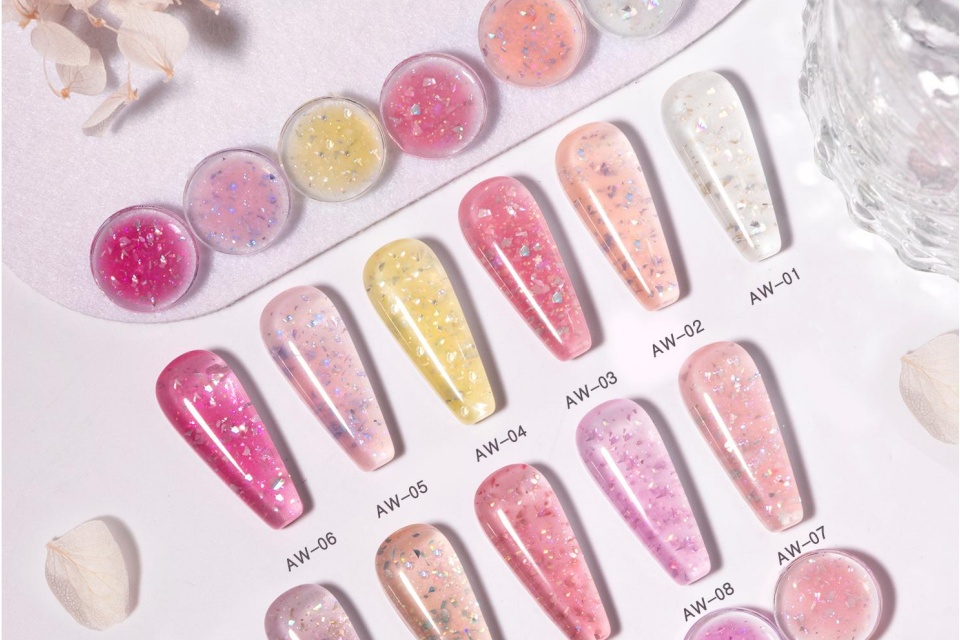
DIY doesn’t reward “professional technique.” DIY rewards guardrails.
PolyGel has guardrails: it doesn’t sprint to the cuticle the moment you blink. That’s why “how to apply PolyGel nails at home” keeps spiking—because people can actually finish a set without a table full of monomer smell and panic filing.
But DIY also creates the worst risk pattern: product on skin + under-curing + repetition.
A university-hospital study in Amsterdam (Jan 2015–Aug 2023, published 2024) found 67 women with allergic contact dermatitis from acrylate-containing nail cosmetics; 97% reacted to HEMA (2-hydroxyethyl methacrylate) on patch test, and 80% cleared after avoiding acrylate products. (PubMed) That “97% HEMA” number should make any brand team sit up straight.
And a separate tertiary-center cohort (Rambam Medical Center, Israel) reported 3,828 patch-tested patients, with 153/3,828 (4%) showing nail acrylate allergy; among those suspected and tested with an extended nail series, 153/396 (38.6%) tested positive, and 22/153 (14.4%) would’ve been missed if only HEMA was tested. ([PMC][5])
Do you see the pattern? “It’s just nails” turns into “lifelong sensitization,” and then dentists and surgeons suddenly care a lot about what you did at home.
Most comparisons are fluff. Here’s the practical version.
| System | What it feels like in real work | Where it wins | Where it bites you |
|---|---|---|---|
| PolyGel (acrygel) | Putty-like, stays where you place it | Control, slower learning curve, lower “flooding” risk | Under-curing risk if you build thick; easy to get lazy with skin contact |
| Acrylic (liquid + powder) | Fast-setting, technique-heavy | Speed in skilled hands; strong structure | Mix ratio and environment swings; odor; high rework if you’re off |
| Hard gel | Self-leveling, glassy strength | Thin overlays, clarity, strong apex | Flooding/leveling mistakes; curing discipline matters |
| BIAB / builder in a bottle | Thinner builder gel, often self-leveling | Fast overlays, short extensions | Not the same strength as a full sculpt; still curing-sensitive |
If you’re doing “builder gel vs PolyGel,” the question is really: are you sculpting structure (PolyGel) or reinforcing a natural nail (builder)? Your product catalog should separate those jobs cleanly. (Best Gel Polish)
Here’s the ugly truth: “odorless” doesn’t mean “risk-free.”
Two ingredients matter in the real world conversation:
Why should you care?
Because regulators care.
The European Commission explains that TPO was classified as a CMR category 1B reproductive toxicant via Commission Delegated Regulation (EU) 2024/197, and that classification triggers a cosmetics prohibition that applies from 1 September 2025 in the EU—covering both placing on the market and professional use. (single-market-economy.ec.europa.eu) That’s not a blog opinion. That’s compliance reality.
And the U.S. FDA, while generally stating nail products are allowed when used as directed, still frames the conversation in “use safely, avoid harm” terms—and that gap between “allowed” and “used correctly” is exactly where DIY damage happens. (U.S. Food and Drug Administration)
So when a product screams “HEMA-free” or “TPO-free,” don’t clap. Verify. Ask for documentation. Put it in your QA workflow. (Best Gel Polish)
People search “best PolyGel nail kit” because kits hide complexity. Brands feed that.
But the “best” kit isn’t the one with the most glitter. It’s the one that makes full curing more likely, reduces skin contact, and gives consistent viscosity batch to batch.
A kit that includes a predictable PolyGel format and application flow (tube/jar control gel, proper slip solution guidance, curing specs) beats a “100-piece mega bundle” every time. (Best Gel Polish)
And if you’re a supplier doing private label, I’d push you to stop treating safety as a checkbox: build it into sourcing, formulation choices, and lot-level testing, then talk about it like an adult. OEM/ODM pages love to sell “custom,” but the real differentiator in 2026 is boring: documentation, repeatability, and fewer surprise reactions. (Best Gel Polish)
Pros:
Cons:
If you want PolyGel to keep “taking off,” the industry has to stop pretending these cons don’t matter. Clinics are literally publishing the numbers. (PubMed)
PolyGel nails are a UV/LED-cured nail enhancement made from a thick acrylic-gel hybrid material that you shape before curing, combining acrylic-style structure with gel-style curing and finishing in one system, typically applied as overlays, extensions, or sculpted sets using forms or tips. (Best Gel Polish) They’re also sold as “acrygel.” The main benefit is control during shaping.
PolyGel vs acrylic comes down to structure and curing discipline, because both can last 2–4 weeks when properly prepped, built, and finished, but acrylic relies more on mixing skill while PolyGel relies more on full UV/LED curing through the entire thickness of the enhancement. (amsterdamumc.org) In salons, acrylic still wins for speed in expert hands. PolyGel wins when you want fewer “ratio” problems and cleaner shaping.
PolyGel vs gel nails mainly differs in viscosity and workflow: PolyGel is paste-like and stays where you place it, while many builder or hard gels self-level more aggressively, which can speed pros up but also increases flooding risk for DIY users and newer techs. (amsterdamumc.org) Both are still acrylate-based systems. Both demand careful curing and minimal skin contact.
Applying PolyGel nails at home means building thin, controlled layers that fully cure under a correctly rated UV/LED lamp, keeping uncured product off skin and cuticles, and repeating short cures per layer instead of trying to cure one thick blob, which raises under-curing and allergy risk. (PubMed) Use forms or full-cover tips if you’re new. File after full cure, not before.
Builder gel vs PolyGel is a job-selection problem: builder gel is typically used to reinforce and slightly extend natural nails with a more fluid self-leveling behavior, while PolyGel is better for sculpting stronger structure and extensions because its thicker acrylic-gel hybrid body holds shape before curing. (Best Gel Polish) If you mostly do overlays, start with builder. If you sculpt length and apex, PolyGel is usually easier to control.
The best PolyGel nail kit is the one that reduces skin contact and increases the odds of full cure by pairing a stable-viscosity PolyGel format with clear curing specs, reliable lamp guidance, and a sensible application flow, because under-cured acrylates are strongly linked to allergic contact dermatitis. (PubMed) Ignore “huge bundle” marketing. Look for documentation, consistency, and realistic instructions.
If you’re building a brand (or rebuilding one after returns and angry allergy emails), treat PolyGel as a compliance-and-quality product, not a viral trend. Start with the PolyGel formats your customers can actually use, back it with QA metrics, and align your ingredient strategy with where EU regulation is headed. (Best Gel Polish) For private label or bulk supply options, check the OEM/ODM path and reach out with your target market and compliance needs. (Best Gel Polish)
[5]: https://pmc.ncbi.nlm.nih.gov/articles/PMC11571230/ ” Is the Use of the Extended (Meth)acrylate Series – Nails Justified? Characterization of Nail Acrylate Allergy in a Tertiary Medical Centre – PMC “