Talk to Our Expert
Our sales and engineers are available all the time, you can ask your specific requirements to our sales, and inspiration to our engineer here.

Gels don’t “stick.” They polymerize, and they only behave like they’re glued down when the bottom layer actually wets the nail plate, cures evenly, and stays flexible enough to survive real life—handwashing, hot showers, keyboards, detergent, and that one drawer you always slam shut.
It works. Usually.
But the minute you skip base coat, you’re basically asking a rigid plastic film to bond to a surface that’s slightly oily, slightly wet, constantly shedding microscopic layers, and bending every time you open a can.
Why do people still skip it?
Because the industry keeps selling “easy gel,” and “easy” always means someone’s quietly deleting steps.
Here’s the ugly truth: a gel base coat is not decoration. It’s the boring engineered interface layer that decides if your set lasts two weeks…or looks like a potato chip by day two.
Three jobs. Not cute. Necessary.
First: adhesion. Most base coats lean on acrylate/methacrylate chemistry (yes, that family—2-HEMA shows up a lot) so the formula can wet the nail plate and crosslink under LED/UV. When that network forms cleanly, it becomes a stable anchor point for the rest of your gel stack.
Second: stress management (a fancy way to say “your nails flex, and gel hates that”). Your natural nail bends. Color gel is usually stiffer. The base layer acts like a shock absorber so you don’t get micro-lifting at the cuticle line, sidewalls, or free edge.
Third: barrier + protection. Pigments stain. Glitters can be abrasive. Over-prep (aka “filing like you’re sanding furniture”) thins nails. A base coat helps reduce direct contact between nail plate and the rest of the system so you can stop chasing longevity by chewing off keratin.
What it doesn’t do? Fix sloppy technique. Fix a weak lamp. Fix flooding. Fix under-curing. If you’re curing gummy gel under a shiny shell, base coat can’t rescue you.
If you want to see the product categories this maps to, start with the plain gel base coat collection and compare it to a gel top coat—they’re built for different jobs, not different aesthetics.
I’ll be blunt: most “gel ruined my nails” stories aren’t about nails. They’re about skin.
And the trigger is usually the same messy combo: cuticle flooding + wiping mistakes + under-cure. Uncured acrylates sitting on skin (sidewalls, cuticle, fingertip) are a known sensitization problem, and once sensitization happens, it’s not a cute little inconvenience. It can follow you into other methacrylate exposures.
A 2023 clinical review on HEMA reported recent contact allergy prevalences above 3% in the USA/Canada and roughly 1.5%–3.7% in Europe, with nail cosmetics singled out as a major driver: 2-HEMA clinical review (2023)
And patch-test clinic data doesn’t exactly calm me down. A 2024 paper out of Amsterdam UMC linked nail-cosmetic allergic contact dermatitis strongly to 2-HEMA (and basically said: if you’re going to test, you’d better test for it): Amsterdam UMC nail cosmetic allergy paper (2024)
So yes, “protects nails under gel polish” can mean staining protection. But in practice, it also means running a tighter system—thin coats, clean margins, full cure—so you’re not smearing reactive goo onto living skin.
If your market cares about it (and many do now), look at a HEMA & TPO-free base coat option and then don’t do the classic mistake: acting like “free-from” gives you permission to be sloppy with curing.
You don’t need a microscope. Lifting tells you what you did wrong.
And yes, I know—people want a single magic fix. There isn’t one. Lifting location is basically a crime scene (and base coat is usually the first suspect).
Free edge chips? That’s often edge stress + no capping. Cuticle “halo” lift? That’s usually flooding, thick ridges, or cure problems. Sidewall peel? Prep missed the corners, or the brush never pushed product where it needed to go.
Here’s the cheat sheet I wish more brands printed on the bottle label (they won’t).
| What you see | Most likely root cause | Why base coat is involved | What to do next time |
|---|---|---|---|
| Lifting near cuticle (a “halo”) | Flooding skin, thick base coat ridge, or under-cure | Product on skin doesn’t bond; thick ridges cure unevenly | Keep a thin base layer, leave a hairline gap, clean edges before curing |
| Sidewall peel | Nail prep missed sidewalls; brush pressure inconsistent | Base coat didn’t wet the full nail surface | Dehydrate evenly; use controlled brush strokes to “push” base into corners (without touching skin) |
| Free-edge chips | No capping, nails flex a lot, or brittle ends | Base coat didn’t reinforce edge; color/top coat takes the stress | Cap the free edge with base + top; consider a colored rubber base for flexible nails |
| Whole nail “pops off” | Oil/moisture, contaminated surface, or wrong lamp | Base coat never formed a stable network | Wipe, dehydrate, confirm lamp wavelength (often ~405 nm LED), cure to spec |
But first—stop over-filing.
Seriously. Stop.
A nail plate isn’t a workbench. If your “prep” sounds like a construction site, you’re already losing (and you’ll keep losing, because you’ll keep thinning nails until nothing holds).
Here’s what actually works, in the unsexy order:
And if you’re doing salon supply or private label, this is where reputations go to die: people obsess over shade names while ignoring batch consistency, cure clarity, viscosity drift, and lamp compatibility. If you want to see how a supplier frames that, check the quality assurance process before you sign anything.
This confusion costs money. And it makes beginners think gels are “random.”
Base coat is engineered to bond down and play nice with the nail plate. Top coat is engineered to resist scratches, staining, solvents, and daily abrasion up top—different hardness targets, different shine package, different behavior (wipe vs no-wipe). If you swap them, you can get wrinkling, dullness, early chipping, or a manicure that “looks cured” but isn’t.
If you want the “catalog view” of how brands separate these categories, browse the gel polish catalog and look at how base/top are positioned relative to color systems.
Yet. You’ll see it.
Regulators don’t care about trends. They care about exposure patterns, bad actors, and ingredient narratives that refuse to die. In California, DTSC moved in 2024 to propose listing nail products containing methyl methacrylate (MMA) as a “Priority Product” under the Safer Consumer Products program (translation: closer scrutiny, more paperwork, less tolerance for sketchy claims): DTSC proposed action (Nov 2024)
No, that doesn’t mean “all gel is bad.” It means the space is maturing, and sloppy practice will get punished—by consumers first, then by regulators, then by chargebacks.
A gel base coat is the thin, clear bonding layer (usually acrylate/methacrylate oligomers plus photoinitiators) that cures under LED/UV to create a stable interface between your natural nail plate and the colored gel, improving adhesion and reducing early lifting, peeling, and staining when applied and cured correctly. Yes, you need it for most gel systems. Skipping it turns your manicure into a gamble.
A base coat is a purpose-built adhesion layer designed to wet the nail plate, cure into a crosslinked film, and provide a chemically compatible surface for color gel to lock onto, which helps the system resist flexing stress and reduces the chance that pigments or uncured residues irritate skin around the nail. Color gels focus on opacity and shade stability, not bonding “down.”
Applying gel base coat correctly means laying a very thin film that avoids skin contact, fully covers the nail plate (including sidewalls), and is cured to the manufacturer’s time under a lamp with the right wavelength, because flooding the cuticle or leaving thick ridges increases under-cure risk and creates edges that lift first. Keep a tiny margin at the cuticle. Clean up before curing. Cap the edge.
The best base coat for flexible or peeling nails is typically a more elastic “rubber base” style formula that cures into a tougher, slightly thicker, stress-absorbing layer, so the color coat doesn’t take the full bending load and chip at the free edge; it still needs thin, even application and full cure to avoid soft spots. If your nails move a lot, a colored rubber base can also simplify your stack.
Base coat and top coat are different resin systems: base coat is engineered to bond to the nail plate and stay compatible with the layers above, while top coat is engineered to form a hard, scratch-resistant, stain-resistant surface film with specific gloss and wipe/no-wipe behavior, so swapping them often triggers adhesion failures or dullness. If you want one place to compare categories, start with base coat versus top coat.
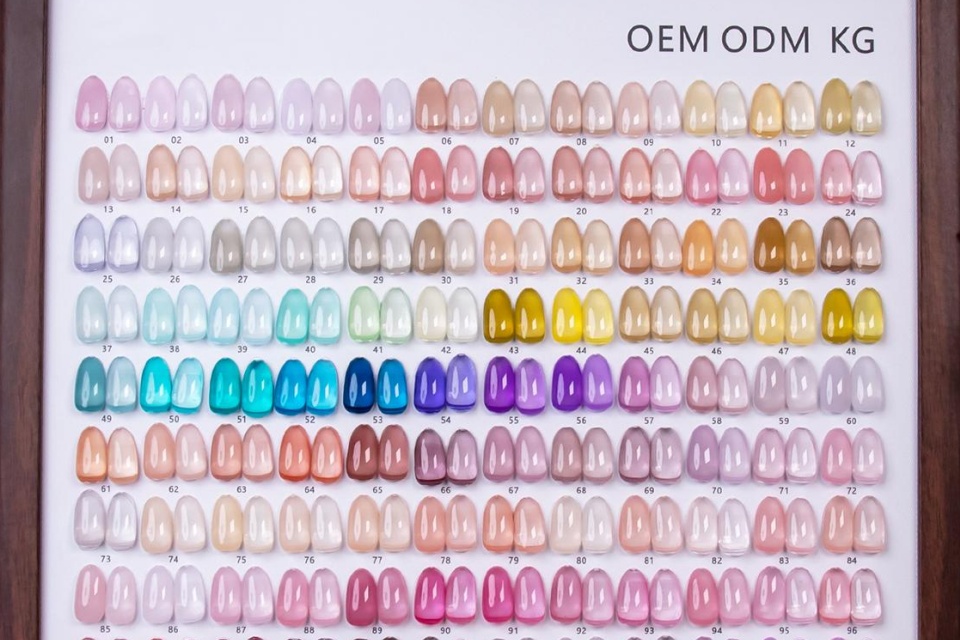
If you’re building a gel system that lasts (or sourcing for salons), don’t start with color. Start with the bond. Browse the gel polish catalog to map your full system, and if you’re doing private label or bulk runs, talk to the team about OEM/ODM services so your base coat specs, curing guidance, and QC claims match what you’re actually selling.